Introduction
What is Hemophilia A?
Hemophilia A is a genetic disorder that effects blood clotting. It disproportionately effects males due to its X-linked nature. It is most common in cases where there is a family history of Hemophilia. It is typically diagnosed at a young age via blood testing.
Symptoms
Hemophilia A is caused by a mutation in the coagulation factor VIII, abbreviated as F8C. F8C is a clotting factor gene, so any significant changes in F8C result in the body’s inability to stop bleeding and results in the following symptoms:
- • unexplained bruising
- • excessive bleeding
- • bleeding in joints and organs
- • joint pain or stiffness
- • possible bleeding around the head or brain
Brief History
-

Historical Recognition
C. 500 AD.
Historical record of Hemophilia in The Talmud
-

1st Modern Description
1803
John Conrad Otto published "An account of an hemorrhagic disposition existing in certain families."
-

Discovery of Hemophilia A
1952
Hemophilia A distiguised from Hemphila B
-

Discovery of factor VIII
1944
Dr. Alfredo Pavlovsky discovered difficienvy in Factor V111, and treatments. Birth of modern Hemophilia A science.
Molecular Genetics
Hemophilia A is an X-linked recessive disorder caused by a mutation in the F8 gene. The specific location of the gene is referred to as Xq28, meaning that it is on the 28 th band of the q region of the 28 th chromosome. This band is located right on the telomere of the chromosome. The F8 gene consists of 26 exons and 25 introns. It codes for 2351 total amino acids, and these amino acids are what come together to form the Human Coagulation Factor VIII protein. The Human Coagulation Factor VIII protein is very important because of its role in the coagulation cascade, which is what allows blood clotting in humans to occur. In order for coagulation to occur, Factor VIII has to be activated to become Factor VIIIa. Factor VIIIa is then used as a co- factor to Factor IX in the cascade, which ultimately produces Factor X and leads to clotting. A lack of this Factor VIII protein, which is what occurs when the F8 gene is mutated in hemophilia A patients, thus leads to an inability of blood clotting to occur. This causes what would be minor cuts and scrapes in unaffected people to be fatal wounds in patients with hemophilia A. In some severe cases, spontaneous internal bleeding may occur, and often times, this is also fatal. The Factor VIII protein that the F8 gene codes for consists of six domains in the inactive form, and these domains are as follows: A1, A2, A3, B, C1, and C2. However, there are only five domains in the active form. This is because the cleavage and release of the B domain is what causes the active form of the protein to be produced. The A domains are important because they give the protein a copper-binding ability, while the C domains are important because they are what allow the protein to bind to phospholipids and thus have cell membrane activity. The severity of hemophilia A depends on what sort of mutation the affected individual has in their F8 gene. The most common mutation that leads to a severe form of hemophilia A is characterized by an inversion of intron 22 with intron 1. This accounts for roughly 50% of severe hemophilia A cases. Other severe hemophilia A cases are mostly caused by the deletion of certain exons, and there are also mutations that can lead to less severe forms of the disorder.
Model Organisms
There are two main model organisms used for Hemophilia A: mice and dogs. Each has its advantages, as mice are easier to use for genetic work especially for larger populations, and dogs provide a larger model with a blood volume more comparable to humans. Click on an option below to learn more about the organisms:

Mice

Dogs
Environmental Interactions

Age of First Treatment
The most commonly mentioned environmental factor is age of first treatment. This factor has been heavily researched and there is lots of data to support the younger treatment is started the better the patient outcomes are.

Breast Feeding
There has been some evidence to suggest breast feeding might play a role in the severity of Hemophilia A symptoms. However, reasearch has shown there is no protective effect associated with being breast fed. The results are largely inconclusive but with advancements in technology there is the potential for further data to be generated and more conclusive results to surface in the future.

Microbiome
In recent years, microbiome science has been exploding. The microbiome has been linked to everything from asthma to cancer. Research has shown that a connection between the gut microbiome and Hemophilia A is highly probable. However, not much data is available and there are no conclusive results.

Need Further Research
As technology advances, and more funding is allocated towards hemophilia research more light will be shed on environmental factors. With the gaining popularity of microbiome research and advances in computing lots more data should be able to be produced leading to conclusive results.
Conclusion
New gene therapy technologies are on the verge of being developed for hemophilia A treatment. One example can be seen with the combination of CRISPR/Cas9 and stem cell technologies that has been used in experiments with mice. Promising results have been seen with regard to treating hemophilia B in mice, but there is still a lot of work that has to be done before any of these technologies can be used in humans. Not as much work has been done with hemophilia A, but there is also hope that these technologies can eventually be used to treat it as well. In addition to the CRISPR/Cas9 treatment that is being developed, there has also been work done that involves inserting the Factor VIII protein into human genomes through the use of vectors. This is also still being perfected, but there will likely be some progress made on this front very soon.
Credits
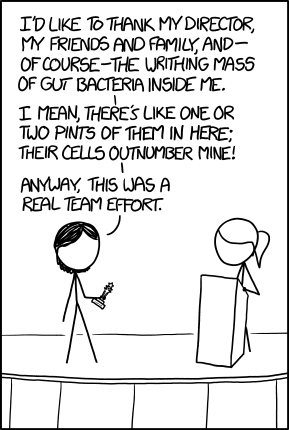
“Team Effort” Creative Commons XKCD
Project Authors
Mia Kotalik, Aditya Gautham, Jacob Ludwig
Works Cited
Marilyn J. Manco-Johnson, M.D., M.D. Thomas C. Abshire, Amy D. Shapiro, and Brenda Riske M.D. 2007. "Prophylaxis versus Episodic Treatment to Prevent Joint Disease in Boys with Severe Hemophilia." The New England Journal of Medicine 375. Sood, Suman L., Dunlei Cheng, Amy D. Shapiro, Craig M. Kessler, and Nigel S. Key. 2017. "Chronic Kidney Disease in the U.S. Hemophilia Population: A Cohort Study." Blood Journal 130.
Shi, Qizhen et al. “Syngeneic transplantation of hematopoietic stem cells that are genetically modified to express factor VIII in platelets restores hemostasis to hemophilia A mice with preexisting FVIII immunity.” Blood vol. 112,7 (2008): 2713-21. doi:10.1182/blood-2008-02-138214
Bailey, Regina. “Sex Linked Traits and Disorders.” Thought Co. Updated 2018 Oct 5. https://www.thoughtco.com/sex-linked-traits-373451
Images
Header - "Red Blood cells" by SciTechTrend is licensed under CC PDM 1.0, https://search.creativecommons.org/photos/0154214c-fee9-4a26-843b-6524f3539cf6
Icons made using adobe Spark licensed under CC.